
NDIS Transport Funding Funding: Core, Capacity Building, or Activity-Based? Explained
Transportation is one of those things we often take for granted. Getting from A to B is usually simple for some of us, but for many NDIS participants, it can be complicated.
Whether it’s getting to therapy, heading to work, or participating in community activities, reliable transport support is essential to help you gain independence and quality of life.
Many participants navigating NDIS transport funding feel overwhelmed due to a lack of knowledge on where to claim transport costs.
One common question we hear from participants is: Where do I claim transport costs from? Is it from the Core budget? Capacity Building? Or linked to activities?
Our guide breaks down and simplifies everything you need to know so you can feel confident about making your claims and avoiding simple mistakes.
Decoding the Three Types of NDIS Transport Funding
NDIS transport funding is generally allocated to any participant who cannot use public transport without considerable difficulty due to their disability. Funding considers any applicable taxi subsidy scheme, and it does not cover transport for carers to move their family members with a disability for every commitment.
One thing to understand with NDIS transport funding is that it does NOT exist as its own line-item category. Depending on how the transport is used, transport costs can be claimed under different sections of your plan.
Understanding this difference is important, particularly when calculating transport costs under NDIS travel or when planning for a plan review.
When to Claim Transport from your Core Budget

Your Core Supports budget is meant to support you with day-to-day activities. This is typically where you have the most flexibility with your plan.
You can use your Core Supports funding for transport when delivered as part of another service, commonly referred to as Activity-Based Transport. This covers costs that arise while a support worker assists with daily tasks, community participation, or medical appointments.
Activity-Based Transport is considered part of support delivery rather than a separate transport service.
Claims can include:
- Worker’s time – the time the support worker spends driving you is billed at their agreed hourly rate.
- Additional costs (non-labour) – with prior agreement, you can utilize Core funds for activity-based costs like parking, tolls, and per-kilometre vehicle rate.
Some common examples of valid core claims include:
- A support worker driving you to a doctor’s appointment as part of your daily assistance.
- A support worker driving you to a social event or to the movies.
- A support worker providing transport for assistance with grocery shopping.
Nonetheless, it is important to note that incorrectly claiming transport can result in potential audit issues or claims being rejected. Therefore, avoid these:
- General expenses. Core funds cannot be used for your own car registration, insurance, or petrol.
- Informal support. You generally cannot use NDIS funds to pay friends or family to drive you.
- No prior agreement. Providers cannot charge for travel unless it is clearly outlined in your service agreement.
Note: It is important to understand that Core supports are different from transport allowance (recurring transport funding), which is paid directly to your bank account regularly for personal travel like taxis and Uber.
Using Capacity Building for Travel Independence Goals
Unlike Core Supports funding, Capacity Building funding centres on helping you develop skills and independence to manage your transport in the long term. While Core funding pays for the ride, Capacity Building, particularly the Increased Social and Community Participation Category, provides you with the skills to get there yourself.
In this context, transport-related supports are about learning how to travel independently. This may include:
- Training for public transport: This covers a therapist or support worker accompanying you on a bus or train to specifically teach you how to read timetables, use a Myki or Opal card, and press the stop button.
- Route planning: This entails building cognitive or digital skills, such as identifying landmarks or using Google Maps, so that you don’t get lost.
- Safety awareness: This teaches you what to do in case you miss the bus, the train gets cancelled, or how to ask for help in public.
- Developing confidence when accessing community spaces.
Funding received under Capacity Building does not pay for the cost of transportation. If you use Capacity Building funds to simply catch a ride to the shops without any active goal of learning to do it independently, the NDIS may flag this as an incorrect use of funds.
Capacity Building funding must always be connected to a specific goal in your plan, like wanting to learn to travel to work independently.
Understanding NDIS Transport Funding Levels
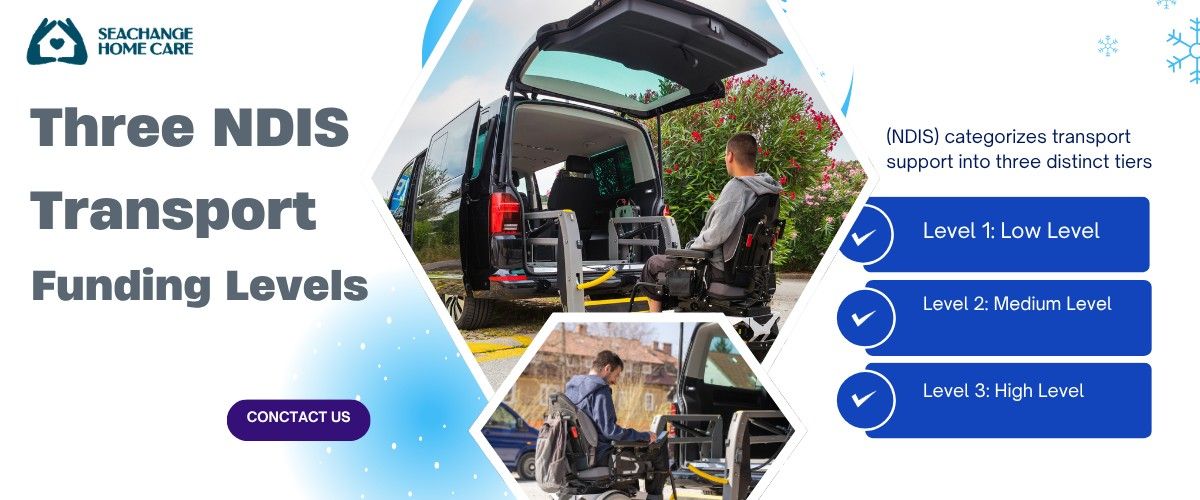
While support categories explain how transport fits into your plan, NDIS transport funding levels determine how much funds are allocated to you.
In most cases, participants receive one of the three levels of funding:
- Level 1 (Basic): You may receive up to $1,784 per year for occasional community access. This funding is meant for participants who are not working, attending day programs, or studying.
- Level 2 (Moderate): You may receive up to $2, 676 per year for participants studying or working part-time (up to 15 hours a week), attending regular day programs or leisure activities.
- Level 3 (High): You may receive up to $3,456 per year for frequent work or study commitments (more than 15 hours a week).
Note:
Funding levels = how much money you receive
Support categories = how that money is used (core for rides, capacity for training)
If your work or study hours increase, you may be eligible for a higher NDIS funding level; hence, always keep your plan manager in the loop!
It is important to have a clear understanding of both concepts to use your NDIS transport funding efficiently.
Tips for Tracking and Auditing Transport Claims

Managing your NDIS transport funding is as important as understanding it. Poor tracking can result in your budget running out mid-plan or facing stressful rejections. Stick to the following tips to remain compliant:
- Keep a Trip Log
Keep a record of the date, destination, and the support worker who assisted you. This makes plan reviews smoother.
- Check Each Invoice
Before your service provider claims from your Core budget, ensure the kilometres claimed and the time spent travelling align with what actually happened.
- Documentation is Crucial
Keep your receipts and Service Agreements organized. Electronic storage of receipts, for example, digital copies of taxi receipts are acceptable and easier to store for the recommended five years for audit purposes.
- Monitor your expenditure
Access your plan manager’s portal or the NDIS Portal to review your balance monthly. If you notice you have a ‘spike’ in transport expenditure (spending more than usual), you may need to modify your schedule or request a plan variation.
Claims must always align with Service Agreements that outline your travel costs. This is one effective way to avoid claim issues or potential repayment requests during audits and plan reviews.
Concluding Remarks!
Understanding NDIS transport funding shouldn’t have to be difficult; however, it needs some clarity. By knowing where transport falls within your plan, how different support categories apply, and how NDIS transport funding affects your budget, you can make informed decisions and avoid common mistakes.
When used appropriately, your transport funding becomes more than just a way to travel. It becomes a tool to gain greater independence, participation, and confidence every day!